Showing posts with label Clicker training. Show all posts

Tuesday, February 7, 2017

Training Tuesday: Training Tools

Dog training tools abound. There are literally hundreds, or thousands, of tools to use when training your dog. The Positive Pet Training blog hop this month is focusing on sharing a few training tools, but it is so hard to choose what to share.

I'm going to share potentially the most controversial tool first: a muzzle.

Training Equipment-3618
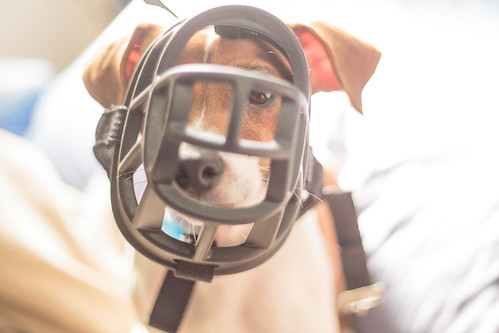
Ptera wearing Koira's muzzle as a full-face-mask.


A lot of people don't think muzzles have any place in positive training. Others think that only "bad dogs" wear muzzles. And neither of those things are true. Muzzles can certainly be used wrong, but there is nothing about them that is inherently against positive training. Properly introducing a dog to wearing a muzzle, being mindful of the situations in which they are asked to wear the muzzle, and making sure to be your dog's advocate can make muzzles a super positive experience. The number one thing that I like the most about using a muzzle is that other people tend to give more space to a muzzled dog, more so even than when you as the handler tell them your dog needs space, or any color of leash or ribbon tied to the leash. Part of this is taking advantage of the above preconception that "bad dogs" wear muzzles, so people try to avoid those "bad dogs" and part is that people see a dog wearing a muzzle as serious, while an owner saying their dog needs space doesn't appear as important. If my dog can comfortably wear a muzzle, and by doing so, she gains the space she needs to feel comfortable while out on walks, then that is what we will use a muzzle for. Of course, muzzles are useful in many other ways as well. I could do an entire post about it. Lets just say that muzzles are awesome and leave it at that.

The other training tools we are using right now are for an online class we are taking.

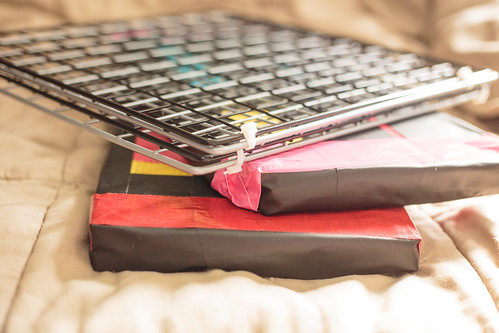
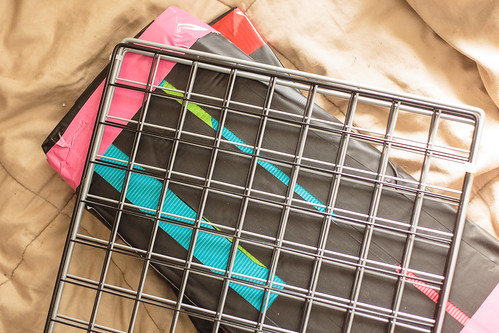
Training Equipment-3629
Two platforms and a gate


The class is to teach dogs positions (front, heel, offside heel, behind, etc), and it uses a few tools to help explain the criteria to the dog along the way.

Training Equipment-3626
Our platforms are super ugly, but they totally work

The platforms are made of foam and taped together into a height of about 2-3 inches or so. Mine are homemade and ugly because I am cheap, but they work just fine. The platform is not the position the dog is supposed to take. Rather, the dog learns that whenever the platform is on the ground, they should go stand on it. Placing it in relation to the human so that the dog is in "front" or "heel" gets the dog used to the picture of where they are going to be. The cue is introduced and solidified by switching between multiple platforms before the platforms are ever faded away.

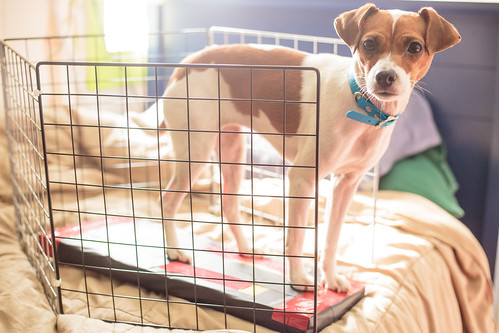
Training Equipment-3625
Ptera standing awkwardly on a platform with the gate around her- just for fun

The gate is used both with and without the platforms as a non-aversive pressure to help the dog understand proper positioning. An example would be using it alongside the handler, far enough away for the dog to comfortably be next to the handler, to help the dog understand how to stand straight when coming into heel, rather than swinging their butt wide.

Along with these tools, we use two of the most important tools a trainer can have- a good working relationship with your dog, and plenty of rewards. I develop a relationship with my dogs by asking them to work, and by making work fun. My dogs respond by enthusiastically working with me, asking for more when we are done, and having fun with me. If either of us isn't having fun, that is when we need to stop and take a break (or, well, it is one step past where we should have taken a break!). Rewards for my dogs include a lot of things: treats of all kinds; tug toys; throwing a ball or toy; wrestling/personal play; and praise. Each of those has a long history of reinforcement as a reward.

Muzzles, gates, and platforms are just a few of the tools I use when training specific things. Rewards and a personal relationship are things that I use every time I train my dogs.

What kinds of things do you use while training? What tools do you think are the most essential?


Monday, March 7, 2016

Recalls

Last week at the park, I was reminded of a time, years ago, when Koira wouldn't come when called. It wasn't that she never came when called, but that she often would simply choose not to, or choose to come most of the way but not close enough to catch.

March 20-5179


I had taken Koira for a walk down to the local park in the morning before heading to work. We were about 1/3 of the way through our walk when I spotted a large black lab standing in the middle of the field we were walking past, with no human in sight. So I went over to see what was going on. Most of the time, in cases like this, the human will pop out of the tree cover or something and I just keep walking. This time, a car pulled into the parking lot and the woman driving rolled down her window and let me know that this was her dog and she just couldn't catch him. She'd tried getting in the car and driving away (just out of sight) to see if she could catch her dog that way. No dice.

Feb 4-4262


I actually spent the next 45 minutes or an hour or so helping her try to catch her dog. He was smart to all of the classic tricks. No food was going to lure him in. No game of fetch would bring him close enough for a grab. No other dog on a leash would entice him within reach of a human. He was wise to being cornered. Sitting/laying down brought no response. I eventually left and continued on with our walk. I'm not sure how that story ends. I assume that she caught her dog at some point and made it home, but since she had been at the park for two hours already by the time I met her, I am not sure if she made it home before dark 6 hours later or not.

As I talked to her (we tried everything to catch this dog, even walking down to a part of the river that dead ends in an attempt to corner him), she said she really didn't want to use a shock collar on her dog, but didn't know what else to do when he acts like this. I gave her a few suggestions, and a story of personal experience. Because years ago, Koira wasn't much different from this dog.

April 1st-5293


We would go down to the park for a walk, have a great time, and when we got back to the parking lot area, I couldn't for the life of me catch Koira. She would stay just out of arm's reach and no treat or toy was enough to lure her in. I often had to have someone else catch her, and I was lucky that she would let other people close to her. But I could see that if it continued, she would start dodging all humans. We easily could have been this owner and her black dog.

I fixed Koira's recall problem in the same way that I recommended to this exasperated dog owner. First, the dog doesn't get to be off leash for a while. A long line is invaluable, and can be made super cheap with lightweight cord and a leash clip. Knots tied every few feet down the cord give you something to grip by stepping on the long line if needed. The long line temporarily prevents the dog from performing the undesired behavior while giving you a chance to do something about it. Long lines aren't training, though, and can be annoying to use long term.

GoPro Under Water-6304


While using a long line on a walk or while playing fetch, I often stopped and grabbed Koira's collar, gave her a treat, and then continued our walk or our game. The idea was to stop her from thinking that every time I touched her the fun would end. Since Koira's issue was specifically at the parking lot area of the park, I made a point of changing out walk route so that we walked past that area multiple times, so she would learn that not every time we were in that place did the fun end. Throughout the walks, treats were given for voluntarily checking in, and for coming when asked to.

When she was reliably doing this on a long line, I took the long line off and did the same thing. Instead of just doing a collar grab while giving a treat, I started clipping her leash on for a second, giving a treat, and then taking the leash off again and letting the fun continue. Sometimes I would keep her on leash for a little while, sometimes I would take it off immediately after snapping it on. Putting on a leash does not equal the end of the fun. This whole time, I made sure we walked back and forth past our problem area (the parking lot) over and over. Sometimes we would walk straight past with no leash clip. Sometimes she would get called over and get a treat and then we would keep walking. Or clip the leash on, keep walking, treat, and then back off leash to play. And when it was time to leave, I didn't always wait until we were near the parking lot to leash back up. I would make the last 5-10 minutes of our walk be on leash sometimes, so that she knew that being on leash didn't mean the fun was over.

I was lucky in a few ways. Koira is naturally interested in working with me, and she is easy to convince that a game is fun. That worked in my favor. I got good advice on how to fix the problem from the start, so even though I let the problem behavior happen for too long before starting training for it, I knew what to do to fix it. And I had a lot of free time. I worked a ton of part time jobs, but they were mostly flexible, evening, or part days, so I could afford to go to the park for a few hours almost every day. Being able to spend plenty of time there made the training go much faster than if we only went to the park once a week. And I suppose our park is a big benefit too- it isn't fenced, but it does allow dogs to be off leash on the trails year-round, and in the sport fields in the winter. So while that initially caused the problem, it also allowed me to work through it.

Ray Benson Snow Park-7974


Today, Koira has a great recall, and a natural inclination to check in. Since working through this problem thoroughly all those years ago, she has never tried to dodge when I want to catch her. I haven't had to ask anyone else to catch my dog. And I haven't had to be that person at the park with the totally untrained dog. But I was there. I can't judge anyone else in that position, because I was there. I was that person. I just have to hope that because I was there, and managed to get through it, and now have a dog who is often complimented at the park for her great recall and attention to me, that I can help the other owners who are suffering through it now.

Irish Bend Stream-2768


I don't know if the black lab's owner will take my advice. Along with giving her basically the same advice I wrote here, I gave her the name of a great local dog training place that actually has a class that is specifically for training a reliable recall. I have no idea if she will take any of my advice, or if she will decide to take the easiest-for-right-now method of using the shock collar she is reluctant to use. I hope she decides to go with positive methods. Her dog will be happier, she will be happier, and she will be able to develop a great relationship with her dog through the training that will last for years to come. I hope that next time I see them at the park, her dog will be happy to be caught, or will be on a long line working through it.

Birthday-8505

And I hope that, because I was friendly and helpful, that she will think of positive training methods in a positive light. I know too many people who, at the first mention of a shock collar, would have started talking down to this dog owner, or verbally attacking her, or telling her all the ways she is wrong. And I know that, had I started out that way, no other advice or help I tried to give would be likely to be well received. No, I don't approve of using shock collars. I think there are much better methods for training something like a recall, and that these better methods create a dog who is happy to be with you. So while I hope that this specific owner does decide to take the time to train a happy, eager recall, I also hope that if you are in the same situation, where you see an owner struggling and they mention using an aversive (shock collar, prong collar, or whatever), you don't attack them. Most of the time, they are at the end of their patience and they don't know what other options are available to them. Don't turn them off from positive methods by giving them a negative experience.


Monday, March 11, 2013

Facebook Training Challenges

So, a few days ago, I posted a status update on Facebook. It went something like:

"Think I can teach Pallo to stick his nose in a bowl of water and blow bubbles before the end of the night?"

The first comment on this status was a friend of mine, who simply said "dare ya."

Hah! Well, I couldn't resist daring her back, to try to teach HER dog to blow bubbles before I could teach MY dog to do it. She took up the challenge and we invited a few other facebook friends to participate as well. In all, I think we had five people take up that challenge late on a Thursday evening. And, we all had a total blast.

We all successfully trained this trick not just in that one night, but in about 10 minutes for each of us. We all ended up totally soaked, and all had a ton of fun. I don't think any of us thought, starting out, that blowing bubbles would be such a fast and easy trick to train. Or that we would have such fun training it.

A few minutes after we finished with training bubbles, one of the participants had an awesome idea. That we should have a Facebook group specifically for doing training challenges like this. So, before I even did anything else, I went and created one. And now, I invite you to join us.

The basic is pretty simple. Members of the group can create events where they give a time period and a trick to train, and everyone who wants to "attend" the event simply does their best to train their dog to do the suggested trick in the time allotted. Three types of challenges exist:


Blitz: Super fast, low-or-no notice challenge
Challenge: Notice of 12 hours or more, up to a few hours of training time
Epic: a trick that will require many hours of training over the course of days or weeks

So, if you are interested in joining us and are on facebook, come on over! The only purpose of this group is to have fun with dog training and help motivate each other to get up and do some silly fun training. No politics, no training discussions outside of the challenges, just good clean fun with a common goal. 

Saturday, November 3, 2012

A bit of fun

Wednesday night I took the dogs up to Salem to My Dog's Gym. We practice flyball there every Thursday night, and every year they have a Halloween party, and we go. My goal this year was to win the costume contest, but there was a lot of fun stuff going on there as well.

I played around with the dogs some. Before too many people got there, I spent some time trying to teach Koira to "strut" and she was doing really well. I was getting 3-4 steps of strutting by the time we stopped. Since we had never tried it before, I thought that was pretty good for a first session, especially with all the craziness around us of other dogs, people arriving, etc.

As the party got started more, I switched out dogs and brought Pallo in. I ended up having him on the other end of the leash when they announced we were going to play Musical Chairs. The dog version is to do musical platforms, with each dog needing to stop on a platform (be it whole body, 2 feet, or even just one foot) whenever the music stopped. I've never done platform work with Pallo before.

We did a few warm up rounds of walking around during the music, then stopping on a platform when the music stopped. There were plenty of platforms for everyone who wanted to play, so that we could get the idea of it. Pallo figured out pretty quickly that being on the platform got him treats (though at first he thought he needed to be on the platform, laying down, and being "ashamed"). Turns out there is a big edge toward winning when your dog is super gung-ho on jumping up onto any platform within leash reach. We managed to take the game in the end, after a really fun time playing with a ton of other people and dogs. Pallo really won it for us, as in the last one, with two dogs and one platform, all I had to do was get him headed toward the platform and he simply bolted up onto it.

After the game was over, I got Koira back out and costumed up both the dogs. There were some other really great costumes as well, with one owner-and-dog pair dressed up as flying monkeys, a few dressed as pumpkins, and some other great ones. But, me, Koira, and Pallo ended up taking the Best Overall prize (there was also Scariest, Cutest, and Best Duo). No pictures, though, because I was a bad blogger and forgot my camera...

Hope everyone else had a great Halloween with lots of fun. And that your November starts off amazing. And good luck to everyone participating in NaNoWriMo this year! I totally forgot it was coming up, so when I remembered yesterday, I registered and got something started, but I have zero confidence of getting it finished with no planning, no solid ideas, and a really busy schedule ahead of me.

Sunday, November 13, 2011

Rear end awareness training

Quick post of a few training videos with the dogs. I have started doing some rear end awareness training with them, since I think both of my dogs could use it. Plus, it will be useful for training some fun tricks later on.

Koira and Pallo are both working on learning how to step sideways with their back feet while keeping their front feet on a target. Koira has been doing much better with this than Pallo, who still doesn't seem to get the concept either of the front foot target being important or that he has a hind end that can do anything to be rewarded for.


Pallo and Koira have also learned to back up in front of me while I walk forward. I am now training a rear-foot target using the back up command. The dogs get clicked and treated when their back feet get on the target placed behind them.

Tuesday, August 30, 2011

Starting a flyball dog- Jump drills, motivation, direction

You've decided to start flyball training with your dog. Your dog is motivated by food or toys and you are willing to dedicate some time and effort to the training process. But where do you begin?

Motivation:

Find the toy or treat your dog is excited about and willing to work for. I prefer using a long (4+ feet long) tug toy, and will put effort into getting a dog to play with a tug. Other people successfully run their dogs for various toys (stuffed, tugs, treat-baited, even laser pointers) or treats. I just find a tug to be easier for me and an effective motivator for my dogs (though Pallo took 2 months to become the crazy tugging maniac he is today).


Jumps (2 person, 1 dog drill):

When a new dog comes to our class, they start out with back-chaining over jumps. Four jumps are used in flyball, and back-chaining just means that we teach them the jumps one at a time. Starting close up over jump 8 (jumps are numbered in the order the dog crosses them, 1-4 on the way to the box, then 5-8 on the way back to the handler, so jump number indicates both which jump and which direction the dog is moving), the dog is held by one person close to the jump while the handler stands or crouches on the other side of the jump with food or a toy held out over the jump to the dog. Most dogs will easily go over the jump to their handler, where they are then rewarded. (We don't recommend using a sit-stay to keep the dog behind the jumps until the handler can get to the end of the course, then releasing the dog from the stay. Part of this drill is to build speed, desire, and drive, which is best built when the dog is restrained, allowing them to pull against the person holding them.)

Both dog and handler move back in increments to give the dog more options. It can go around the jump, but is encouraged and rewarded for going over the jump. This is the method we use to teach all four jumps, backing up a little bit if the dog shows a desire to run around the jumps and slowly adding another jump in, then backing up to 15 feet from jump 5. The dog can then complete what we refer to as a run-away (other teams will sometimes have other names for this). Basically, a run-away is the dog being held with its back feet on or just in front of the flyball box, then recalling quickly over four jumps to the handler.

Once the dog is doing a run-away, the handler begins to change their position to running away from the dog, with the toy/reward held out in the LEFT hand, veering to the RIGHT side of the run back area. This is important for when other dogs are added in later. It will help your dog run on the right side of the lane (which reduces the risk of a collision over a jump if another dog ends up loose on the course) and keeps the handler out of the way of other running dog/handler teams.

ETA: As Patty pointed out in a comment below, some people like to use gates to keep the dogs in line when first teaching them the jumps. We've never really found this to be needed on our team dogs, though we have one older dog who began with a different club who we do fence in because of a long-term habit of skipping out on the jumps.

Variations:
Once dog and handler have run-aways solidly down, you can add in variations by changing the spacing of the jumps (in a course, jumps are spaced 10 feet apart), changing jump height (you can keep them all the same or vary the height of them), knock the jumps over, etc. This will help your dog stay safe on a course even if a jump has been knocked out of place or knocked over during a race. In an active race, if the dog continues to clear jumps as if they are still upright, the run is clean even if the jump is out of place or knocked over.

Another variation is instead of holding the dog at the box, directly in line with the jumps, you can move the dog off to the side, a little at first, then more as they are solid. This helps teach a dog to still come back over the jumps even after a ball bobble at the box sends the dog far off to the side (I can proudly say, this is something Koira excels at, even when really far over, she will still come back over the jumps).

Other Jump Drills (1-2 person, 1 dog drill):

You can also practice other jumping drills with your dog to improve respect of the jumps (important to teach dogs to not run into or smack their feet into the jumps, preventing both injury to the dogs and damage to the equipment), improve athleticism, get the dog thinking about what it is doing, and overall conditioning. We don't run this in class, but I practice them at home and find them to be a helpful additional training drill.

Two drills borrowed from agility training are four-squares and pinwheels. Both work in a similar way, with the jumps close together and the handler near by. It is useful to have an additional person to assist, but can be done with a sit-stay, unlike the run-away jump drill above.

For four-square, set up four jumps as the four sides of a square. Start by having the dog on one side of the square, sitting just in front of the jump, with the handler on the far side of the square. (Starting from a sitting position helps build rear-end muscles for more powerful jumping.) Call the dog, and reward when the dog pops over both jumps. More complicated routines with the four-square add in a turn, with the dog on the outside of the handler, then the handler will toss the toy/reward across the other two jumps of the square, encouraging the dog to complete those as well.


Pinwheel is set up with the ends of the jumps in the middle, with each of four jumps spreading out like rays. Start sitting, as in the four-square drill, and encourage the dog to jump over each jump in turn.


Another jumping drill is power-jumping. Basically, you set up jumps, in a number in excess of 4, then do restrained recalls over those jumps. Eight or more jumps can sometimes be used, helping build endurance and drive. Just be careful not to overdo it, as this is a lot of work for your dog! Then again, it is a lot of work for the handler too, as you should always be running away during restrained recalls.


Direction (2 people, 1 dog):

The other thing we always do at the first class is try to determine which direction the dog turns. Like people are right or left handed or footed, dogs turn easier either to their left or their right (as many people involved in agility or herding probably already know about their dogs). Some dogs show a strong preference one way or the other, while other dogs seem to have little to no preference. Make sure when trying this that you are not in a location with lots of distractions, as it may effect the outcome.

The way we test for this is pretty simple, but requires two people. The handler holds the dog. The other person walks straight out in front of the dog about 20 feet away, places a ball on the ground (or a toy, or a treat if the dog will not pick up a ball yet), stands stationary on the other side of the ball from the dog. The handler releases the dog to get the ball, and takes note of which direction the dog turns to return- left or right (the dog's left or right, always). Repeat 3 times. Take note of which direction the dog turns more often. This is the direction the dog turns, and will be important when you start box training.

One last thing:


Though not essential, it can be easier to train some things if your dog has a touch-stick trained behavior. This means that your dog will touch the marked end of a stick on command, including following the moving stick, jumping, etc to reach that marked target on the end. Try to refrain from using a ball on the end of a stick, and even if you have the hand-touch behavior, try transferring that behavior to a touch-stick. I taught this behavior with a clicker, but you don't need to. In fact, you don't need this behavior at all, I just find it makes training easier.

Pallo, jumping up to "touch" (note the black part at the end of the stick)
Sunday, July 3, 2011

Happy Fourth Everyone

Koira and Pallo wish everyone a happy Fourth tomorrow.

Koira is super excited. (But only because I got her a new tug toy, since she doesn't really like fireworks.)


Pallo doesn't really care about fireworks at all.


But he does love the new red white and blue tuggie


I worked with both of the dogs last year leading up to the Fourth. I purchased those small white poppers, and did a pop, treat, pop, treat method of desensitization. Then, as fireworks went off in increasing amounts around the neighbor hood each night, I went and sat outside, with the dogs, calmly reading a book or similar. Somehow, this all worked, and Koira, scared though she is of buses and garbage trucks, is now only mildly worried about fireworks, and then only the super loud ones.


Koira is enjoying the hot weather, and showing off her famous smile


And I can't put up a post without a picture of Pallo's paws, apparently


Enjoy the Fourth!

If you get the chance, head on over to Never Say Never Greyhounds. They posted an amazingly moving video of a horse hero named Reckless.

Monday, June 27, 2011

Monday, training, rabbits, and more

I finally think I figured out how to share a video, and thought I would make one of Pallo learning a new trick. I want to teach him to "line up" with the goal of him ending up between my legs. I have seen a lot of agility and flyball people use this trick with their dogs, but, mostly, it seems fun to learn and show off.

The end result I am looking for:

Image and video hosting by TinyPic

The video was the second 2-3 minute session of having him try this trick. It only took a couple tries luring him in the first session before he caught on, but as you can see with his last try in this video, he doesn't quite have the hang of it yet. Also, you can see that "roll over" has become one of his fall back behaviors, which he tries whenever he gets confused.


Pallo also got to try out some herding... Kind of. What actually happened was my mom's rabbits discovered a hole they can use to get out of the fence, so I was asked to come visit and catch them. Chasing rabbits by yourself rarely ends up with catching anything at all, so I took Pallo with me and sent him out and around to the other side of the bunnies, and told him to find them. He did an awesome job, went out in a wide circle, then coming back in toward the fence, driving the rabbits in front of him towards me (and I had a net on a long stick for catching the creatures). He even would stop on cue, or back off, if he was freaking them out too much, driving them too fast, or in the wrong direction. So, while Pallo has never seen sheep, ducks, or cows, he is an excellent rabbit herder.

Once the three baby rabbits who were loose were caught, I introduced the dogs to them.

Koira snuffled the babies all up and down, then decided they weren't all that interesting after all:
Image and video hosting by TinyPic

Pallo smelled them, but was cautious:

Image and video hosting by TinyPic

And, Pallo just wanted me to let them go so he could chase them around some more. Here he is, caught with his mouth open, whining with excitement:

Image and video hosting by TinyPic

And here is the rabbit pen. It has wire along the bottom of the fence, laid on the ground, about 2 feet in from the fence on all sides. They can dig burrows and everything, but the wire discourages them from trying to dig out of the pen. The hutches are where the babies will be kept until they are too big to escape the fence, and where the does go when they are ready to kindle. I spent a long day building this pen so the rabbits would have a lot more room to move, areas to dig, and grasses to munch on. I think they are much happier like this than in a hutch all the time.

Image and video hosting by TinyPic


As for the flyball question I posed in my last post, I agree with everyone that answered. I would consider it box loader error and flag it. I did, when I saw it as a box judge. However, a discussion with a team mate revealed that many judges do NOT consider this a fault. No where in the rule book that I could find does it actually, explicitly say the ball must be in the box when it is triggered by the dog.

But, if it doesn't count as a fault/flag for the ball to roll out of the box, what would there be to stop someone from training a dog to trigger the box, then grab the ball from the ground, and run back? I see little difference between the ball rolling out of the hole versus the box loader placing it on the ground for the dog. I actually tried to read the relevant parts of not only the NAFA manual, but the U-Fli one, as well as BFA, the Australian one, and the South African one, and none of them explicitly mention that the ball must be in the box when it is triggered.

I would have thought this was a given in the sport of flyball. But, if some people don't view it as a fault, don't flag it as a box judge, and some judges don't require it, what is to stop someone from training a dog that has problems catching the ball from the box to simply grab it from the ground?

Have a happy Monday, and enjoy the week!

Tuesday, March 15, 2011

Over-and-backs

I finally got some pictures of Pallo working today by the simple way of visiting a friend while she was at work, and working my dog whenever there were no customers in the store. It does mean I have to appologize for the poor quality of the pictures, because they were taken indoors, and my camera has a hatred of the indoors.

We didn't have a wall to work with, so I just brough my jump and touch stick along and we worked touches and over-and-backs with the stick.

Pallo is always super attentive during training. Notice how the stick I have is black on the tip. When training the "touch" behavior, I only rewarded for touches in that black area, since I want the dog to follow the end of the stick, not the stick anywhere they feel like grabbing it.

Image and video hosting by TinyPic

Pallo goes over the jump. He is already turning back to me before he is fully over the jump, because the stick has whipped away, back to my side.

Image and video hosting by TinyPic

He then jumps back, and I take the stick out of target range, and give him his reward.

Image and video hosting by TinyPic

He got a little more speed on this over, and has to really dig in tight to get the fast, single stepping turn I am rewarding for.

Image and video hosting by TinyPic

You can tell by looking at him that this dog is loving what he is doing, and having a great time out there. Though possibly that was just the sardines he was getting as rewards.

Image and video hosting by TinyPic

He did great, considering this was working in a new location, around one of his favorite people, and with tons and tons of new smells around (my friend works in a tack consignment store, so lots of farm and horse smells in things).

His over-and-backs were very smooth.

Image and video hosting by TinyPic

Koira didn't get her pictures taken, because her limp is back, so no working for her, and leash-walking only. She is going in to the vet for x-rays tomorrow morning though, so hopefully we wil get some answers to what is ailing her.

I did get a video of her limping, as it appeared at the park.


My old digital camera doesn't take the best videos by a long shot, and my netbook can't support video editing, but you can get the general idea of her gait problems. She is limping a little on her right hind, and is generally tight all over in the rear.

Here's to hoping the vet will figure it out soon, so my little girl can be on her way to recovery.

Wednesday, March 9, 2011

Flyball training: touch stick progress

Both Koira and Pallo have made a ton of progress doing training with their touch stick. I managed to (finally) build a jump out of some scrap super-light plywood and my mom's chop saw yesterday. Today, I tried both Pallo and Koira on doing over-and-backs with a touch stick.

Over-and-backs are something I have worked with both of them with before. Pallo learned it when I first started doing flyball training with him, and Koira saw it when I was busy retraining her box turn, the first time. Doing it with the touch stick is way more different than I thought it would be.

What the dogs should be doing is hopping over a single jump (me holding touch stick on the other side for them to go toward). As soon as the dog's front feet are over, I whip the stick back to my side of the jump, the idea being that the dog will quickly hop back over the jump to me after landing on the far side. This is what I refer to as an over-and-back (some people call it a hup-back).

Pallo is a bit hesitant on the return part of this exersize. I'm not sure why, but I think its because the stick is gone before he gets to touch it with his nose. After two sessions today (about five minutes each) he has lost a lot of that hesitancy and is doing the over-and-back relatively smoothly.

Koira still doesn't like touching the end of the stick really, despite having learned the behavior very well. She actually really seems to like this exersize, as she realized after one try that she gets a click and treat without ever having to put her nose on the stick. It also took me a few repetitions before I realized that she needed a little bit of vocal encouragement. Pallo needs me to be quiet, Koira needs me to talk. Once I started asking if she was ready, and then saying "Go touch it" the whole thing seemed to click with her. She very quickly started offering over-and-backs that are incredibly smooth, quick, and enthusiastic.

I will keep doing the over-and-backs, but think I will introduce the wall work soon as well, to give them a new challenge. I know it will improve their turns greatly (though Pallo already has a damn good turn).

I am excited to do this whole new box turn training method. The box turn training is the big nemesis of many flyball trainers, and if the process can be made easier, with a great, solid, high, fast, single hitting box turn as the result, its pretty amazing to think about.

Hopefully I will soon have another person around to help out at training and maybe take some pictures of my pup's working their new skills. I have zero skill at taking a picture while trying to do anything else at all.

Tuesday, February 22, 2011

Training Seminar

I had the good fortune to attend a training seminar taught by Touch N Go this weekend. For those who don't know, they are the world record holding flyball team in U-Fli. Obviously, they have a good bit to teach the rest of us, as they are the first (and I'm not positive, but they may be the only) team to break below 15 seconds.

I attended all three days of the seminar, starting with Green Dogs/Young Dogs on Friday, then with more advanced dogs on Sat/Sun.

A few things I learned that I am going to use on my dogs:

First, a game that cures ball dropping, called the Hand game. I especially plan on teaching this game to Pallo, as he has the ball dropping issues, but I'm sure Koira will benefit from learning it as well.

The idea is that first, you teach the dog a simple hand touch with their nose. Quickly moving on, you teach them to pick up a toy and touch that to your hand. Moving as slowly or quickly as you and your dog are able, you gain distance and variety of toys, as well as eventually making your hand a moving target, first as an empty, wide open hand, then eventually as a fist holding your tug toy. The idea is that in competition, the dog will still bring the ball all the way to your fist, then grab the tug once there.

The other training tip is using a touch stick to train a box turn. Both of my dogs currently have a box turn that isn't terrible, with Pallo's being pretty good. However, I believe that teaching them the touch stick method, and a wall turn, will help their box turns improve and become faster, snappier, and with less of a chance of double hitting.

Pallo picked up right away that the name of the game is to touch the end of the stick with his nose, click, treat. (Generally not a clicker training person, but it makes this particular game easier.) He occasionally forgets, but pretty much has it down. Koira on the other hand started out afraid of the stick for some reason. It wasn't until this morning when she saw Pallo touch, click, treat over and over while she didn't get anything that she even would touch her nose to the stick. Hopefully if I keep up with it, they will progress to doing over-and-backs using the stick quite soon, and from there to wall hits. I haven't decided if I will use it to retrain their box turns, or just do touch stick and wall turn training to help build muscle memory of a proper turn, and see how well it transfers over.

There was a lot more information at the seminar, including jumping drills, striding corrections, and more, but for now, I think these two games are what I will work on. Though, if I can get someone to video tape Pallo's full runs, I might add striding props if it looks like he needs them.