Showing posts with label Training goals. Show all posts

Tuesday, February 7, 2017

Training Tuesday: Training Tools

Dog training tools abound. There are literally hundreds, or thousands, of tools to use when training your dog. The Positive Pet Training blog hop this month is focusing on sharing a few training tools, but it is so hard to choose what to share.

I'm going to share potentially the most controversial tool first: a muzzle.
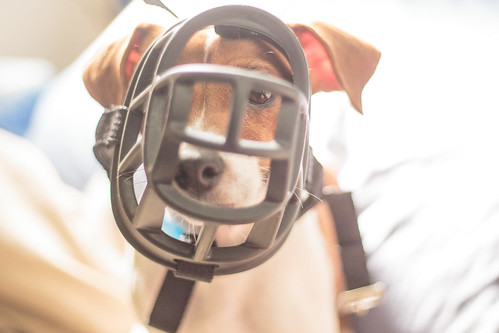
Training Equipment-3618
Ptera wearing Koira's muzzle as a full-face-mask.


A lot of people don't think muzzles have any place in positive training. Others think that only "bad dogs" wear muzzles. And neither of those things are true. Muzzles can certainly be used wrong, but there is nothing about them that is inherently against positive training. Properly introducing a dog to wearing a muzzle, being mindful of the situations in which they are asked to wear the muzzle, and making sure to be your dog's advocate can make muzzles a super positive experience. The number one thing that I like the most about using a muzzle is that other people tend to give more space to a muzzled dog, more so even than when you as the handler tell them your dog needs space, or any color of leash or ribbon tied to the leash. Part of this is taking advantage of the above preconception that "bad dogs" wear muzzles, so people try to avoid those "bad dogs" and part is that people see a dog wearing a muzzle as serious, while an owner saying their dog needs space doesn't appear as important. If my dog can comfortably wear a muzzle, and by doing so, she gains the space she needs to feel comfortable while out on walks, then that is what we will use a muzzle for. Of course, muzzles are useful in many other ways as well. I could do an entire post about it. Lets just say that muzzles are awesome and leave it at that.

The other training tools we are using right now are for an online class we are taking.
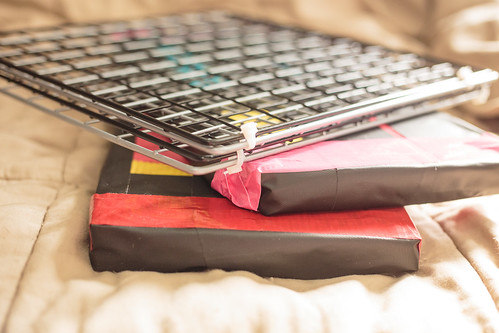
Training Equipment-3629
Two platforms and a gate


The class is to teach dogs positions (front, heel, offside heel, behind, etc), and it uses a few tools to help explain the criteria to the dog along the way.
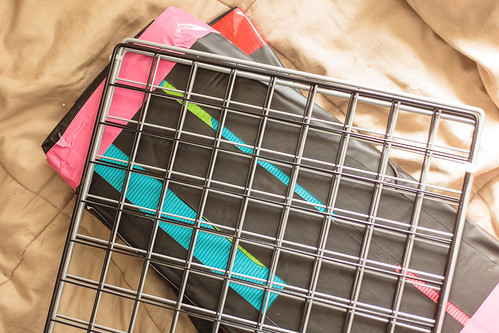
Training Equipment-3626
Our platforms are super ugly, but they totally work

The platforms are made of foam and taped together into a height of about 2-3 inches or so. Mine are homemade and ugly because I am cheap, but they work just fine. The platform is not the position the dog is supposed to take. Rather, the dog learns that whenever the platform is on the ground, they should go stand on it. Placing it in relation to the human so that the dog is in "front" or "heel" gets the dog used to the picture of where they are going to be. The cue is introduced and solidified by switching between multiple platforms before the platforms are ever faded away.
Training Equipment-3625
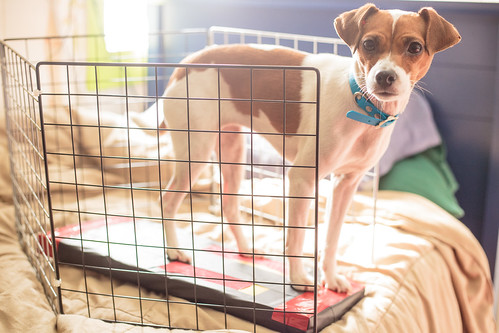
Ptera standing awkwardly on a platform with the gate around her- just for fun

The gate is used both with and without the platforms as a non-aversive pressure to help the dog understand proper positioning. An example would be using it alongside the handler, far enough away for the dog to comfortably be next to the handler, to help the dog understand how to stand straight when coming into heel, rather than swinging their butt wide.

Along with these tools, we use two of the most important tools a trainer can have- a good working relationship with your dog, and plenty of rewards. I develop a relationship with my dogs by asking them to work, and by making work fun. My dogs respond by enthusiastically working with me, asking for more when we are done, and having fun with me. If either of us isn't having fun, that is when we need to stop and take a break (or, well, it is one step past where we should have taken a break!). Rewards for my dogs include a lot of things: treats of all kinds; tug toys; throwing a ball or toy; wrestling/personal play; and praise. Each of those has a long history of reinforcement as a reward.

Muzzles, gates, and platforms are just a few of the tools I use when training specific things. Rewards and a personal relationship are things that I use every time I train my dogs.

What kinds of things do you use while training? What tools do you think are the most essential?


Wednesday, August 3, 2016

Monkey See Monkey Do

Much as I love her, Koira has some habits that I am not particularly fond of. Probably the biggest one is that she gets over the top excited and obsessive. When we go paddleboarding, Koira spends the entire time leaping off the SUP, swimming after the kayaks (I always go on the river with at least one other person, for both safety and fun), climbing back on the SUP and using it as a launching pad again. And barking the entire time, with a deep booming bell like bark.

4th of July-7863
Landshark locked, loaded, and launched!
She loves going paddleboarding. But she isn't the most enjoyable dog to take along in some ways. I said from the beginning that I hoped she didn't end up teaching Ptera all of her bad habits. 
GoPro MoonShine-9052
Obviously Ptera is very excited by Koira's excitement and movement.
Honestly, I should have known better. I guess if I don't want Ptera to copy Koira, I can't take them out together. Because this little JRT has some serious terrier tenacity and high drive, which is just driven on even more by Koira's over the top excitement. I guess I am destined to have crazy dogs on the paddleboard with me. Or swimming after it.

GoPro MoonShine-8914
Monkey see, monkey do. While Ptera doesn't spend as much time jumping off the SUP and swimming, she is confident enough to leap off into the water a few times before she gets cold.

Do your dogs teach each other things? I feel like it can work both ways. A well behaved dog with good habits and routines helps train a new dog to behave the same way. But when that same dog does crazy things like barking her head off and leaping into the water repeatedly (and then turning around to sharkbite the front of the SUP), those habits and behaviors appear to transfer as well.

I see some solo SUP trips in the future for me and Ptera, to try to get some more polite and enjoyable behavior, before the barking and craziness gets too ingrained.

Friday, March 18, 2016

Ptera's First Off Leash Hike

Bald Hill-0228
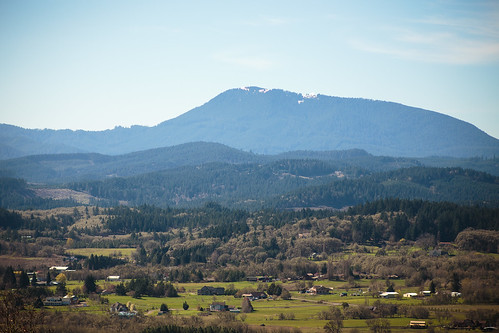
View of Mary's Peak from the top of Bald Hill


Ptera has officially been here for a week. And she has learned so much in that time! Mostly we have been working on the basics- potty training, crate training, and recall. Well, the weather cleared up yesterday, giving us a chance to take a hike up Bald Hill, and it was a great opportunity to get in some recall practice for Ptera.

Bald Hill-0169
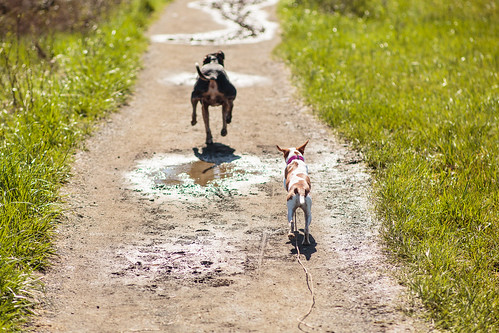
Getting some running in down the trail


I've been spending a lot of time on our walks saying Ptera's name and giving her a treat when she responds- and only saying her name if I m 99% positive she will respond. So for our hike, I put her on a drag line (a 10 foot long lightweight cord with a knot in the end) and practiced off leash recalls from a much greater distance.


Lets just say I am really happy with where we are with her recall right now!

Bald Hill-0188
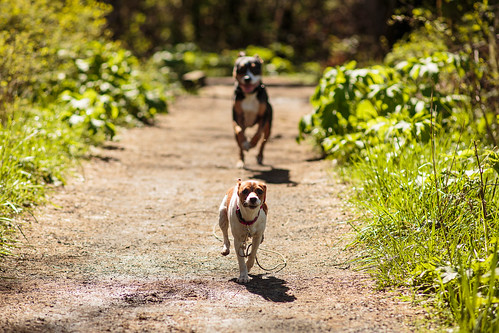
Both dogs coming back when called


Something else Ptera needs work on, which isn't really a training thing, is building muscle. I don't think she really did much other than hang out in the house at her former home, and her total lack of muscle supports that theory. So I have been working on getting her active and moving with an end goal of building muscle and endurance.

Bald Hill-0180
The adorable seriousness of a recall


Ptera is only 6 months old right now, so I don't want to overdo things with her. At the same time, though, her bones and muscles and tendons need to move and be worked and have her do stuff for them to develop properly. So we have been going on lots of walks. I want to build her endurance without overdoing it- I don't want to build up to where she needs a 10 mile walk to chill out! But I do want her fit to the point where she can run flyball all weekend successfully by the time she is competing (dogs must be 1 year old to compete in flyball, and she likely won't compete right when she hits her birthday, because there really isn't any rush).

Bald Hill-0178
Exploring the woods- I don't think she's ever been on a hike before


Leash walks on local streets, down to the local park, and just around town in general are helping build her leash skills (she wasn't leash trained as of last Friday when I picked her up). They are also helping with building confidence, exposing her to new things in a way that I make sure is positive, and of course, helping build some muscle and fitness.

Bald Hill-0204
Koira and her mini me


But really, I prefer to hike my dogs off leash whenever possible. I feel like they just get so much more out of it if they are able to be off leash, smell the smells, check things out, jump over logs, and generally just explore, so long as they are within sight and listening to me if I call them. For that, recall is absolutely required. But I think we're getting it. I'm not ready to take Ptera's drag line off yet, but for a dog I've only had for a week, I am so beyond pleased with where she is in her recall training right now.

Bald Hill-0190
Recall!

Monday, March 11, 2013

Facebook Training Challenges

So, a few days ago, I posted a status update on Facebook. It went something like:

"Think I can teach Pallo to stick his nose in a bowl of water and blow bubbles before the end of the night?"

The first comment on this status was a friend of mine, who simply said "dare ya."

Hah! Well, I couldn't resist daring her back, to try to teach HER dog to blow bubbles before I could teach MY dog to do it. She took up the challenge and we invited a few other facebook friends to participate as well. In all, I think we had five people take up that challenge late on a Thursday evening. And, we all had a total blast.

We all successfully trained this trick not just in that one night, but in about 10 minutes for each of us. We all ended up totally soaked, and all had a ton of fun. I don't think any of us thought, starting out, that blowing bubbles would be such a fast and easy trick to train. Or that we would have such fun training it.

A few minutes after we finished with training bubbles, one of the participants had an awesome idea. That we should have a Facebook group specifically for doing training challenges like this. So, before I even did anything else, I went and created one. And now, I invite you to join us.

The basic is pretty simple. Members of the group can create events where they give a time period and a trick to train, and everyone who wants to "attend" the event simply does their best to train their dog to do the suggested trick in the time allotted. Three types of challenges exist:


Blitz: Super fast, low-or-no notice challenge
Challenge: Notice of 12 hours or more, up to a few hours of training time
Epic: a trick that will require many hours of training over the course of days or weeks

So, if you are interested in joining us and are on facebook, come on over! The only purpose of this group is to have fun with dog training and help motivate each other to get up and do some silly fun training. No politics, no training discussions outside of the challenges, just good clean fun with a common goal. 

Friday, April 13, 2012

Posing

As I read the comments on Wednesday's post, I had a bit of an incredulous feeling going on. Not because people liked the pictures, because frankly, they are some of my favorite in a long time. Mostly, it was the people commenting on how awesome Pallo posed, and how he must be such a "natural poser" for all those pictures.

HAH!

Little do you guys know, I guess. Pallo was a terror to try to photograph at first. The only picture I had of him for a while was the (very unflattering) picture from the Linn County Dog Control's website where I first found him. After Pallo was part of my family for a few weeks, I managed to snap this picture of him on my phone. This was after being at the park for (quite literally) three hours of play time. I used a ball to get his attention.


Pallo's first trip to the beach is documented only in this photo:

A few other early-days pictures of Pallo are the following. Keep in mind that these photos were selected as the best photos of the day. These aren't the outtakes.


Now, part of this was my own photography skills. But, I have to say, that was only part of it. I have certainly improved with the camera in the past two years. However, I was taking perfectly decent pictures of Koira already. The biggest difference between the above photos and my new personal favorite of Pallo is in the training we have done.

Pallo brick drool

Yes, there is a big difference as well in the quality of the camera (especially given that in the early days, the only camera I had was my phone). But, even with the camera I have now, I would not have been able to get this picture of Pallo at the beginning.

So, I thought I would share. Not the camera-specifics of how to take a good dog picture. Lots of people have done posts like that. I enjoy reading them. I may write one someday when I feel qualified to do so. But, I think perhaps more helpful, is the post I want to do.

How to train your dog to pose for the camera.

1: Exercise your dog.
Take your dog out for a run, a game of ball, or any other activity that will tire him out. A high energy dog will not be willing to sit still for happy photos (at least not without more training) until he has had a chance to run off some of the energy. Bonus: A tired dog often is panting in photos, which gives the impression of "smiling" for the camera.

157. "Party Animal" -Show us how your dog likes to have fun today! It can be natural or set up, but lets see what brings out the party animal in your dog. - last day Apr 12

2: Make sure you have plenty of time.
Don't expect to snap off a few pictures in a minute or two and come up with that perfect picture. You will need to spend time working with your dog and taking plenty of bad pictures to get those good ones. When I do a photo session, I will take over a hundred pictures of my dogs, easily (some days I end up with 800+ photos just from that day). Also, make sure you have plenty of space on your memory card and plenty of battery life on your camera, so that those technical aspects won't get in the way.

Canon 9017

3: Get your dog used to the camera
Many dogs are "camera shy", or their people think they are, because the dog takes off whenever the camera comes out. For many dogs, this is a side effect of being told to stay whenever the camera comes out, then having their person upset at them for moving (as often our dogs' stays are not proofed against us moving around, putting a box in front of our faces, and making clicking and vrring noises). Some dogs are really just unsure of the camera being in front of their person's face.

Both of these problems can be worked on by bringing your camera with you. Take your camera out, but don't put it to your face or take pictures at first. Depending on how shy of the camera your dog is, you may want to pair treats with the camera coming out. Others may just want to play fetch with their dogs, first concentrating on the camera being visible, then on actually raising the camera to your face and taking pictures, but with a focus on the dog's continued happy reactions, ignoring the potential quality of the pictures. You just want your dog to get used to seeing the camera in front of your face and getting used to the sounds of the zoom, focus, and shutter. You can even use the shutter sound as a "clicker" and pair it with treats, giving one up every time you take a picture. (I don't treat for every click of the camera, but it may be a method useful for getting started.) Also, shooting "from the hip" can be a good way to acclimate your dog to the sound of the camera without having it cover your face, and can give you some interesting results sometimes.

IMG_0187

4. Train a "wait"
A formal stay is less useful in pet photography than you might think. I prefer to train my dogs to "wait" which for them means they are free to shift position but have to stay in the same area. They can also be released from a wait when I am away from them, while their "stay" must be held until I return to them. The word you use doesn't matter as long as you are clear to your dog what the criteria are. Remember to practice your "wait" or "stay" with your camera. Proof it with the camera in front of your face or with you moving around, as you will want to back up, kneel down, or even lay down, to get a good picture sometimes.

It can help to place your dog up on something, such as a log or a chair, to define the space he is to "wait" in. Using a crate mat as a "wait" space also works, but may not be what you want to always have in pictures.

129. "Au Naturel" - Take a minimalist shot of a dog just being a dog today! - last day Mar 14

5. Learn your dog's happy words
Figure out a way to make your dog look at the camera without saying their name. Using the dog's name can confuse them into thinking you want them to come, as that is most often what is wanted. Instead, try using words to perk your dog's ears up. Koira perks her ears and looks around when I ask her "do you see it?" which gives a great gazing-into-the-distance look. When I want a straight into the camera look, with or without a head tilt, I want the ears up and a happy look. I will ask a few questions such as "do you want some breakfast?" or "do you want to go to the park?" which both include words my dogs know and are phrases associated with actually doing those things.

It may take some experimenting to figure out which words will make a pretty picture, which will gain no response, and which will amp your dog up so much that he takes of running and looking wildly around.

121. "Leap Day" - It only happens every four years! Let's see your dog leaping or otherwise celebrating Leap Day in some way. Feel free to interpret it as you like! - last day Mar 6

6. Stay happy, and leave the frustrations at home
You need to have fun while taking pictures so that your dog believes this is a fun thing to do. If you get frustrated with him getting up and moving, or not looking, etc, take a break and play for a while. Remember to release your dog from his position if you need to do something like change your camera lens or move around a lot so that he doesn't get too stressed having to wait. Remember to praise your dog. Use your voice, treats, or toys in between taking pictures so that your dog is sure this is a fun thing to do. In general, don't try to train and photograph at the same time, and if you do, place the emphasis on the training. It is better to have consistent training than good pictures, because you can always try for that picture again next time.

Happy Shooting!
I hope these tips help out some of you who have trouble getting a good picture of your pups. I really think the number one thing to remember is to have fun, because as long as you are having fun, your pup will have fun as well. And once picture taking is a pleasure for both of you, you will both be wanting to do it more.

For some more animal photo tips, check out Honey The Great Dane's latest post on this same topic!

Sunday, January 1, 2012

It's a New Year

I have a few goals for 2012, which I thought I would share as much to share them as to have a place with them written down, for me to look back on next year to see how far we have come.

Goals for both dogs:

Complete a 52 weeks photo project (more on this later)
Earn both dogs' CA titles (coursing ability, they each need one more Q to achieve it)

Koira's Goals:

Earn Koira's CGC
Earn Koira's Rally Novice title (or at least, give it a good try)
Try out AKC obedience with Koira
Earn Koira's FDCh-G title (Flyball Dog Champion Gold, which she needs just under 1000 points for)
Train Koira's flyball box turn to the point where it stays consistent and four feet, even without the jump board.
Do a Pinups With Pitbulls photo shoot and submit a photo for the calendar.

Pallo's Goals:

Train Pallo's attention while heeling to the point of entering rally novice

Get Pallo's flyball times back down to the 5.0-5.3's he did before the ball retraining, while having him still carry his ball the whole way back
Put together a Freestyle routine with Pallo

Make a dent in the 5,000 points needed to achieve the FMX title (Flyball Master Excellent)


Personal Goals:

Crafting:

Make a baby quilt for my friend who is due in March
Make up a stock of dog collars, and attend at least 2 craft fairs
Finish my Renaissance dress
Complete Pallo's new crate before our next show
Get back into felting
Make a cave-style dog bed for Koira (and hope she actually uses it)

Menu Planning:

Plan a menu every week, with shopping list
Make and freeze extras for ready-made meals

Other goals:

Go back and edit my NaNoWriMo work
Complete the Couch to 5k program
Renew my passport

Monday, June 27, 2011

Monday, training, rabbits, and more

I finally think I figured out how to share a video, and thought I would make one of Pallo learning a new trick. I want to teach him to "line up" with the goal of him ending up between my legs. I have seen a lot of agility and flyball people use this trick with their dogs, but, mostly, it seems fun to learn and show off.

The end result I am looking for:

Image and video hosting by TinyPic

The video was the second 2-3 minute session of having him try this trick. It only took a couple tries luring him in the first session before he caught on, but as you can see with his last try in this video, he doesn't quite have the hang of it yet. Also, you can see that "roll over" has become one of his fall back behaviors, which he tries whenever he gets confused.


Pallo also got to try out some herding... Kind of. What actually happened was my mom's rabbits discovered a hole they can use to get out of the fence, so I was asked to come visit and catch them. Chasing rabbits by yourself rarely ends up with catching anything at all, so I took Pallo with me and sent him out and around to the other side of the bunnies, and told him to find them. He did an awesome job, went out in a wide circle, then coming back in toward the fence, driving the rabbits in front of him towards me (and I had a net on a long stick for catching the creatures). He even would stop on cue, or back off, if he was freaking them out too much, driving them too fast, or in the wrong direction. So, while Pallo has never seen sheep, ducks, or cows, he is an excellent rabbit herder.

Once the three baby rabbits who were loose were caught, I introduced the dogs to them.

Koira snuffled the babies all up and down, then decided they weren't all that interesting after all:
Image and video hosting by TinyPic

Pallo smelled them, but was cautious:

Image and video hosting by TinyPic

And, Pallo just wanted me to let them go so he could chase them around some more. Here he is, caught with his mouth open, whining with excitement:

Image and video hosting by TinyPic

And here is the rabbit pen. It has wire along the bottom of the fence, laid on the ground, about 2 feet in from the fence on all sides. They can dig burrows and everything, but the wire discourages them from trying to dig out of the pen. The hutches are where the babies will be kept until they are too big to escape the fence, and where the does go when they are ready to kindle. I spent a long day building this pen so the rabbits would have a lot more room to move, areas to dig, and grasses to munch on. I think they are much happier like this than in a hutch all the time.

Image and video hosting by TinyPic


As for the flyball question I posed in my last post, I agree with everyone that answered. I would consider it box loader error and flag it. I did, when I saw it as a box judge. However, a discussion with a team mate revealed that many judges do NOT consider this a fault. No where in the rule book that I could find does it actually, explicitly say the ball must be in the box when it is triggered by the dog.

But, if it doesn't count as a fault/flag for the ball to roll out of the box, what would there be to stop someone from training a dog to trigger the box, then grab the ball from the ground, and run back? I see little difference between the ball rolling out of the hole versus the box loader placing it on the ground for the dog. I actually tried to read the relevant parts of not only the NAFA manual, but the U-Fli one, as well as BFA, the Australian one, and the South African one, and none of them explicitly mention that the ball must be in the box when it is triggered.

I would have thought this was a given in the sport of flyball. But, if some people don't view it as a fault, don't flag it as a box judge, and some judges don't require it, what is to stop someone from training a dog that has problems catching the ball from the box to simply grab it from the ground?

Have a happy Monday, and enjoy the week!

Thursday, April 21, 2011

Lineup!

Koira ran in a lineup for the first time in well over a year!

With the great progress Koira has been having with doing full runs, we decided today to try putting her in a lineup for the first time since her rather horribly failed tournament last January.

And the best part, Koira ran great! First time out, I ran Koira first, with Raff, a Keeshond on our team, passing into her. Koira didn't even seem to notice him other than dropping her ball once, which may have been from him crowding the lane a bit (or might have been her spitting balls for no reason). Second time out, we switched it around, running Raff first, followed by Koira. Again, she didn't even seem to notice him there, even when I was passing closer (though we didn't do any close passes yet).

Passing and other dogs in general were never a problem for Koira. She has never really been distracted by dogs in the other lane, or had issues with dogs in her lane at all. But, being able to run in a lineup is an important step in training before we can head to a tournament with her. The main issue she has is lack of motivation heading to the box, but running her in a lineup seems to help with that, if anything. Plus, we think that her desire to return to me will eventually help speed her up down to the box as well as from the box.

My next training goal with her is to run her between two dogs, with one before her and one after her. And I will throw a party to celebrate when she single strides the jumps on the way down as well as the way back to me (currently she double strides to the box and single strides back to me).

Pallo did good at practice too, except for tripping and taking out a jump. We were running him at 9", which is his measured jump height. He tapped one jump, then somersaulted into the next one, taking it out completely. Luckily, he was not injured at all. And, he loves flyball so much and has such confidence with it that he ran just fine the rest of the night, not even tapping any of the jumps.

And, just for a bit of a laugh, Pallo trying on booties for the first time.

Image and video hosting by TinyPic